Everyone Has AI Now. That's the Point.
If you use Claude or ChatGPT, you have probably used MCP already without thinking about it. Here is what it is, why we shipped one for symmetRE, and why the edge in real estate AI is starting to live somewhere other than the model.

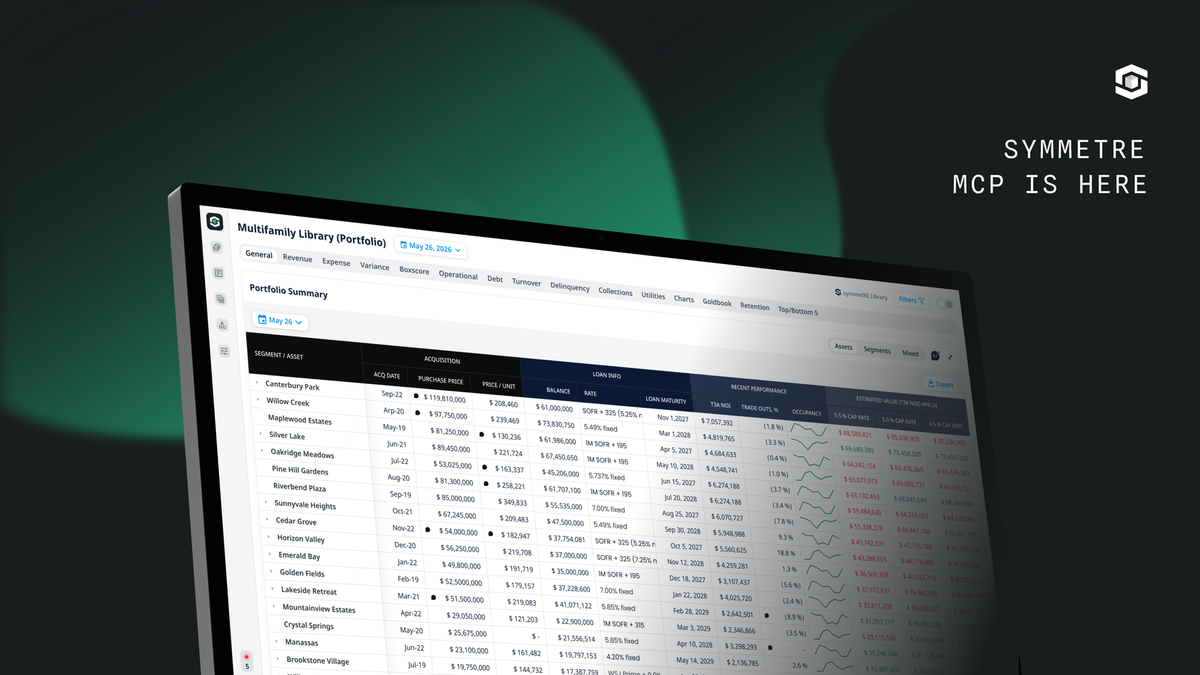
Last week, we launched our MCP connector. If you have not heard of MCP, that’s fair. Most of our clients had not either until we put one in front of them. The name is unhelpful. The thing itself is not.
MCP stands for Model Context Protocol. In plain English, it is the wire that connects an AI model to a data system. When you open Claude and click on a connector to see your calendar or your email, that is MCP. When you give ChatGPT access to a third-party service to read or write something for you, that is MCP under the hood. It is a standard, like Bluetooth or USB-C, for letting models talk to outside data without each vendor inventing its own way of doing it. Anthropic published it. The rest of the AI providers are adopting it.
The symmetRE MCP connector is what lets a client of ours open Claude (or ChatGPT, or whichever AI tool they prefer) and ask a question about their portfolio without uploading anything. The portfolio is already there because the connector is configured. The question comes back grounded in data that is current, validated, and traceable to the underlying transactions.
That is what we shipped last week. The why is more interesting.
AI is not the edge anymore
For about two years, owners and operators have been quietly experimenting with AI (and technology in general). Some have been less quiet about it. There are CIOs running pilots, asset managers trading prompt libraries, a few firms publishing what they have built. Most do not.
What has changed in the last six months is that the experimentation phase is over for this asset class. Frontier models are good enough for serious analytical work. Excel has native AI. Outlook has native AI. PowerPoint has it. Your phone has it. Your accounting software has it. The calendar booking tool your analyst installed last week has it. Whatever investor portal you use has it, or it will by year end.
The implication is straightforward, and it is also the most important sentence in this post:
When everyone has AI, AI stops being the edge. It becomes a commodity.
This is not a bad thing. Commodities are useful. Owning a smartphone in 2026 is not an edge, but you would not run a business without one. AI is on the same trajectory. The question is no longer whether to use it. The question is what you point it at, and what you build underneath it.
The edge is moving to the foundation
If the model is the commodity, the differentiator is what the model is reasoning over.
A real portfolio is messy. The data lives in property management systems your operators control. Definitions of NOI, occupancy, and lease tradeouts vary firm to firm. Numbers move. Books backfill. Post-close adjustments propagate weeks after the fact. The same metric you reviewed in April may not be the same number in June, and that is normal.
A model pointed at raw data will give you a confident answer built on definitions you did not write. A model pointed at validated data, with your firm's definitions baked in, gives you an answer your team can actually use in a meeting. The difference is the layer underneath. Aggregation, semantic standardization, deterministic computation, traceability back to the source transaction. That is what symmetRE has been building for years.
The MCP connector is the part that makes that work directly reachable from any AI tool you choose. The work itself is the foundation.
What we are not
A few things worth being plain about, because the AI marketing conversation has gotten loud and people are tired.
We are not asking you to throw out your existing tools. Your Excel still works. Your property managers don’t need to change platforms or learn something new. Your accounting software stays where it is. Your team's existing workflows keep going.
We are not asking you to pick our AI. If your firm is on Claude, that is fine. ChatGPT, also fine. If a better model ships in a year and you want to move, the open protocol we built on makes the switch a configuration choice instead of a rebuild. We have no interest in locking you into any model vendor, including us, above the data layer.
We are not selling you AI. We are selling you the foundation that makes whatever AI you choose actually useful on your real portfolio.
What you stand to gain from a software partner, not a static tool
One more point, and then we will leave you to it.
The thing that is different about working with us, compared to other software vendors in this space, is that we keep building. We are not a consultant. We are not going to write you a strategy deck and send an invoice. We are not a static tool that did its work in 2019 and is now bolting AI features on top because it has to.
We are a team. We ship continuously. The release we put out last week is one in a sequence that runs forward through the rest of this year and beyond. The work we are doing right now—extending what the AI understands about how your specific firm operates, opening more of the surfaces where AI is useful inside the platform, supporting more of the AI tools your team wants to bring—is shaped, in real time, by what owners are telling us they need.
When everyone has access to the same AI, the differentiator is who you build with. Whose engineers you have on the phone when something is not working the way you want. Whose roadmap reflects the work you actually do. Whose product team treats owners as the buyer they are building for, and not one persona among many.
We are not going to be the right partner for everyone. We are built specifically for owners and operators. We say no to feature requests that would pull the platform toward serving other audiences. We say yes to the harder problems that are specific to the owners we work with.
If that is the kind of partner you want sitting next to you as the next several years play out, we would like to be in the conversation.