The Classic Build vs. Buy Dilemma in the New World of AI
A practical take on what it actually costs to build your own AI analytics platform for real estate, what we've already learned the hard way, and when DIY might still be the right call.


Sound familiar?
Your boss has told you to "go look into AI." With minimal direction and not much help, you’ve been implored to figure out the firm’s AI strategy… Or maybe you are the boss, and you're the one trying to figure out where to start. Either way, this is the conversation happening at almost every real estate firm in the country right now. We know because we hear it from asset management teams every week. They are searching for answers and its hard for them to figure out what is real and what is not right now.
Just last week, a client of ours made this comment while we were talking about the current AI landscape - “This is starting to feel a lot like the Dot Com bubble.” What he meant by that wasn’t related to an impending crash. He was referring to the frenzy around a new technology, the broader lack of knowledge on it in the market, and the seemingly thousands of consultants & experts coming out of the woodwork to “help.”
You don’t have to go very far to understand what he was talking about. Every other post on LinkedIn right now seems to be from an AI influencer / consultant gushing over the latest models feature release. Doing their best to give you FOMO for all the amazing things you are missing out on. Just comment “AI” and for $50 / month they’ll let you in on all their secrets.
While AI is an incredible tool, building your own product with it is certainly not as easy as your feed would make you believe. I decided to put together the below to provide a high-level realistic viewpoint of what you should expect should you venture down the build it yourself path. I would rather give the blueprint than watch people get taken for a ride.
Let's actually do the math
The below is the bare minimum needed if you’re serious about building something dynamic, accurate, & scalable. I won’t touch on (just yet) all of the custom development items that will be required for the numerous data problems you will run into… things like rent roll carry forwards & property management transitions to name a couple. Those alone took us months to solve using multiple teams of 3+ engineers on each.
Until then… Here's what it costs (in dollars, time, and stress levels) to build an effective portfolio-wide AI analytics & reporting tool using public models like Claude, GPT, or Gemini. These estimated ranges depend on the scale and complexity of your portfolio; the larger and more complex, the more expensive it is to build and maintain.
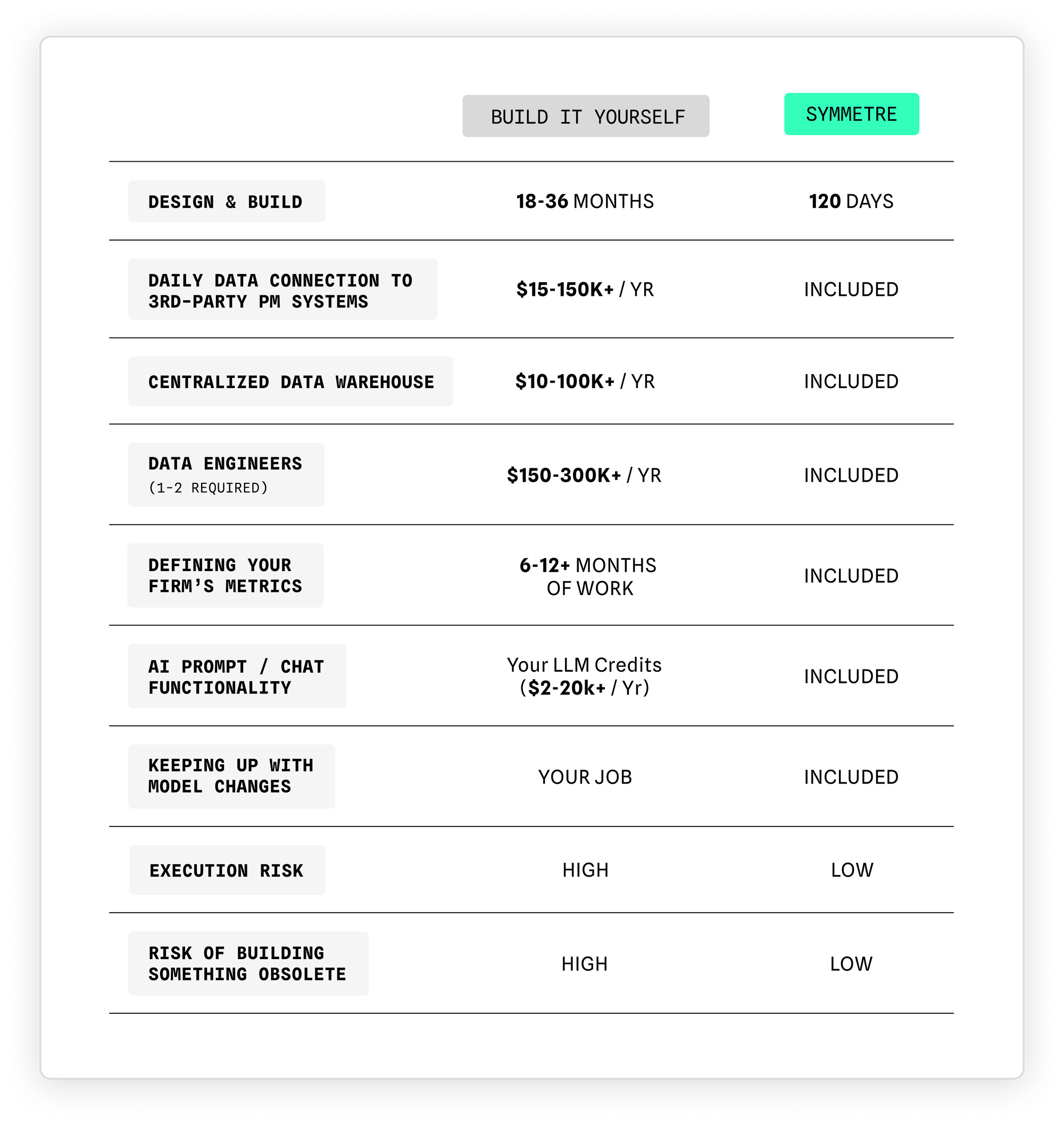
Additionally - here are a few things the table doesn't fully capture:
- The data standardization / metric definition problem is the one most teams underestimate.
- The AI hallucination problem compounds as you increase your data set.
- The obsolescence problem is the one that gets you after you've invested.
- Our CTO Artur already has a piece on this here.
I’ve talked with some owners that have been trying to solve this problem without a data warehouse and are just using Claude memory functions and folder structures. That is like purchasing a car without tires. Sure, you can grind it out on the rims for a short distance but you won’t get very far (i.e. limited amounts of data and not scalable). I’ve also been asked by others if they could use a data warehouse to store the unstructured data but not hire a data scientist or developer to structure, define, and transform it. Now that is like buying a car without an engine. What’s the point? Your AI will not work on unstructured data unless you are good with inaccurate and inconsistent answers.
What we've actually built (so you don’t have to)
This is worth being specific about, because it's where the "we'll just build it" instinct most often underestimates the work.
A useful AI platform in this industry is not one model and a prompt. It's a stack, and every layer has to hold:
- A foundation of tools that aggregate & standardize your data, so the models can answer any question across the portfolio and provide an answer that ties back to validated data.
- A context layer, because every operator and every owner calculates things differently. Your formulas, your variables, your knowledge base, all available to the model so it answers using your math.
- An MCP layer that lets users plug in their own Claude, ChatGPT, Gemini, or whatever ships next.
- A daily ops function: mapping new GLs, catching PMC errors, monitoring for hallucinations, & updating definitions as the business changes.
Five-plus years of work. Twenty-plus software engineers. A roadmap that is still adding new surfaces every quarter. We say that not to flex, but because if anyone tells you a small team can replicate this in a couple of quarters, they are either selling something that doesn’t work or they have not yet tried it themselves.
When DIY is the right call
We tell prospects this in person and we'll tell you in writing: if you have a narrow / specific workflow that you want to automate, something like a memo template, a recurring summary, or a well-defined task, AND a technical person in-house, you can absolutely build it yourself…and probably should.
Scale also matters. If you have unlimited patience, significant capital, and the expertise to do so, building internally is certainly a solid option. With that said, it is hard enough to run a strong real estate private equity company, do you really want to take on building a successful technology platform, as well? Doing both at the same time definitely isn’t something I would want to undertake having done the software side of the equation. At the end of the day, you just have to ask yourself, is this really the game I want to be playing?
The argument is narrower than "don't build." It's this: build for your differentiated edge, not for your undifferentiated reporting infrastructure. Standardizing portfolio data across PMCs is not your edge. It is everyone's problem. There is no prize for solving it in-house.
Still working it out?
We've got a full guide is coming soon. We mean it. For some firms, with some use cases, building on your own is the right call.
If you want to skip ahead, grab time with us and we'll work through it.